
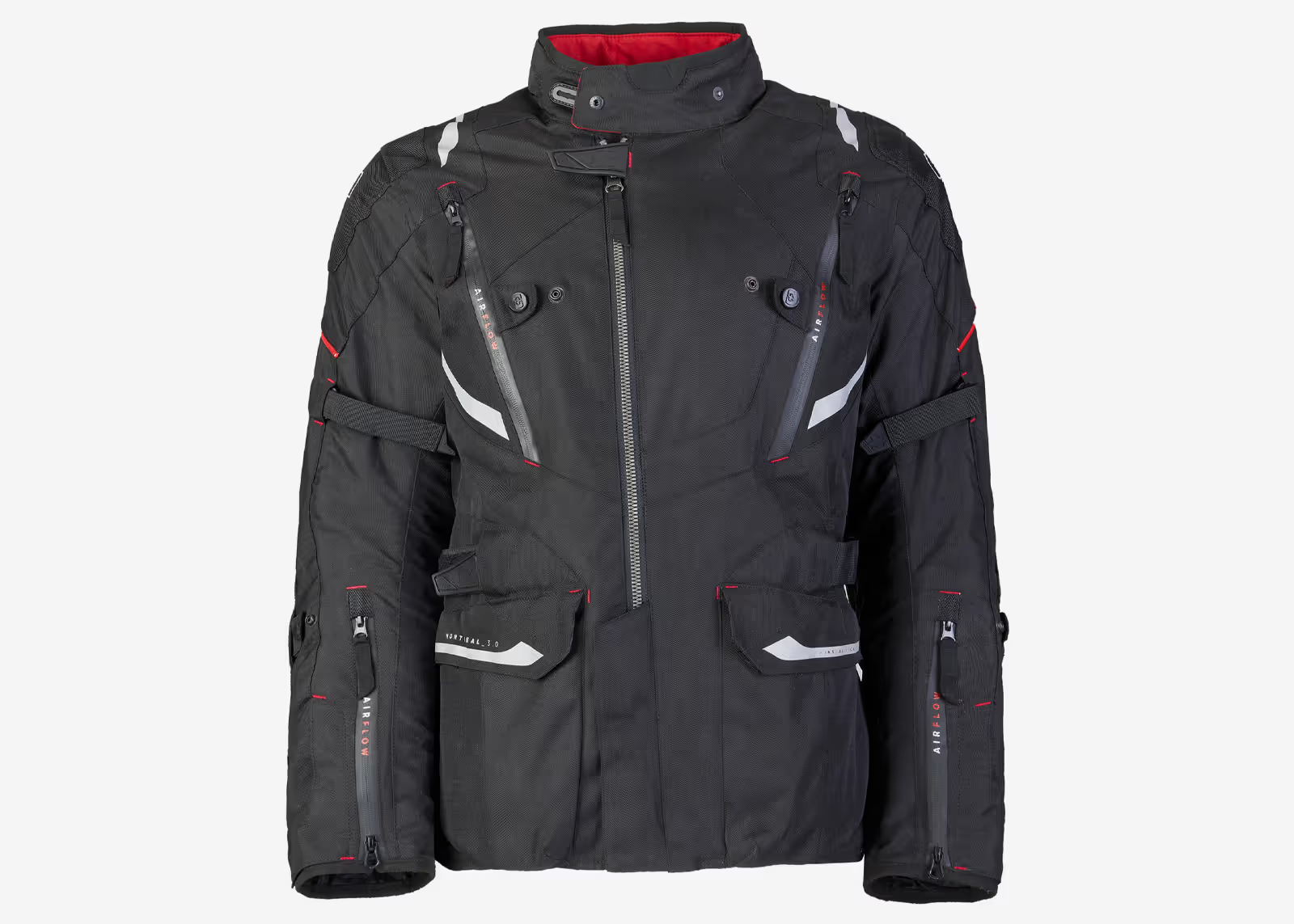
Here's how it works, why it's worth doing properly, and what to expect if you book a session in Auckland.
If you sell clothing online, you've almost certainly seen ghost mannequin photography without knowing it had a name. It's the technique behind those clean, three-dimensional product images where the garment appears to be holding its shape mid-air, no model, no mannequin, just the clothing. It looks simple. It isn't.
What ghost mannequin photography actually is
Ghost mannequin photography, sometimes called invisible mannequin or hollow man photography, is a two-stage process. The garment is first photographed on a mannequin from multiple angles: front, back, and any interior details that matter, collar lines, hemlines, sleeve openings, lining. Then in post-production, the mannequin is removed in Photoshop and the separate shots are composited together into a single seamless image that shows the full three-dimensional form of the garment.
Done well, it looks completely natural. The kind of imagery you see across established fashion retailers and mid-to-premium brands. Done poorly, the cloning is visible, the joins don't sit right, and the image reads as cheap regardless of how good the product is. The quality of the composite is as important as the quality of the photography.
Ghost mannequin vs flat lay vs model: which do you need?
Each approach serves a different purpose and the right choice depends on what the image is for.
Ghost mannequin is the strongest option for ecommerce product listings. It shows garment shape and fit clearly without visual noise, and it's highly consistent across a full range, which matters when you're presenting an entire collection on a website or wholesale platform.
Flat lays work well for social media and styled editorial content. They're faster and more cost-effective to produce, but they don't communicate how a garment sits on a body. For accessories and products where drape isn't the point, flat lays are excellent. For clothing where fit matters, they're a compromise.
On-model photography is the most aspirational format, but also the most resource-intensive. Booking models, coordinating a full shoot, and managing a larger production is the right call for campaign imagery and seasonal heroes.
For most Auckland clothing brands, the most efficient approach is a combination: ghost mannequin for core product listings, flat lays for social content, and model photography for key campaign moments. Many of my clients use all three across a single collection.
Why ghost mannequin works so well for ecommerce
Online shoppers can't try your products on. Every purchase decision is made entirely on visuals, which means the clarity and accuracy of your imagery has a direct impact on conversion rates. Ghost mannequin photography removes distraction and puts the focus entirely on the garment.
The three-dimensional form communicates fit in a way no flat lay can. Consistent styling across a full range looks considered and professional. Interior detail shots answer the questions shoppers have before they commit to buying. Clean, distraction-free images perform well across every platform: your website, Shopify store, EDMs, wholesale catalogues, and PR submissions.
There's also a returns angle. When a product looks accurate to what arrives, customers are less likely to send it back. For smaller and emerging NZ fashion brands in particular, ghost mannequin photography is one of the highest-return investments you can make in your visual content. It positions you alongside much larger retailers without the overhead of a full model production.
What to expect at a ghost mannequin shoot
I've produced ghost mannequin content for a wide range of Auckland clothing brands, from boutique activewear labels to established fashion retailers. The process is straightforward.
Garments should arrive clean, at a sample size that fits your mannequin (if you are providing one) or a standard size 8 for women's, 16 for plus, and Medium-Large for mens. Any hangtags that need to appear in the final image should be flagged beforehand. Before we start I'll confirm the look you're after.
Each garment is carefully arranged on the mannequin for fit and presentation. Complicated cuts, deep V-necks, sleeveless styles, open-back garments, require extra attention at this stage so the composite reads naturally in post. I photograph front, back, and any detail angles needed, including interior shots for the hollow-body composite effect.
Post-production covers mannequin removal, compositing, colour accuracy, tone, and consistency across the full range. You receive web-ready files as standard, with high-resolution files available on request.
Garments can be couriered saving you time not having to be on-site for shoot. I work with brands across Auckland and throughout New Zealand.
Common questions
How many garments can be shot in a day? It depends on complexity. Straightforward styles move quickly. Structured garments, knitwear, or pieces requiring multiple interior shots take longer per piece. Send through your product list and I'll give you a realistic estimate.
Do I need to provide a mannequin? If you have a fitting mannequin you're already using, you're welcome to send it along. Otherwise I have both male and female mannequins in studio. Plus size and kids mannequins are available by special request.
What's the turnaround? Standard turnaround for most runs is within 10 business days. Rush delivery is available for time-sensitive launches.
On AI model photography
I'm currently exploring AI model photography as part of my workflow, using a combination of Midjourney for campaign planning and tools including Sea Dream and Nano Banana for model generation. It's early days and I'm still testing what's genuinely useful versus what's interesting in theory. More on this soon. If you're ready to get started or want to talk through your range, fill in a project brief via the website and I'll come back to you.
If you sell clothing online, you've almost certainly seen ghost mannequin photography without knowing it had a name. It's the technique behind those clean, three-dimensional product images where the garment appears to be holding its shape mid-air, no model, no mannequin, just the clothing. It looks simple. It isn't. Here's how it works, why it's worth doing properly, and what to expect if you book a session in Auckland.
What ghost mannequin photography actually is
Ghost mannequin photography, sometimes called invisible mannequin or hollow man photography, is a two-stage process. The garment is first photographed on a mannequin from multiple angles: front, back, and any interior details that matter, collar lines, hemlines, sleeve openings, lining. Then in post-production, the mannequin is removed in Photoshop and the separate shots are composited together into a single seamless image that shows the full three-dimensional form of the garment.
Done well, it looks completely natural. The kind of imagery you see across established fashion retailers and mid-to-premium brands. Done poorly, the cloning is visible, the joins don't sit right, and the image reads as cheap regardless of how good the product is. The quality of the composite is as important as the quality of the photography.
Ghost mannequin vs flat lay vs model: which do you need?
Each approach serves a different purpose and the right choice depends on what the image is for.
Ghost mannequin is the strongest option for ecommerce product listings. It shows garment shape and fit clearly without visual noise, and it's highly consistent across a full range, which matters when you're presenting an entire collection on a website or wholesale platform.
Flat lays work well for social media and styled editorial content. They're faster and more cost-effective to produce, but they don't communicate how a garment sits on a body. For accessories and products where drape isn't the point, flat lays are excellent. For clothing where fit matters, they're a compromise.
On-model photography is the most aspirational format, but also the most resource-intensive. Booking models, coordinating a full shoot, and managing a larger production is the right call for campaign imagery and seasonal heroes.
For most Auckland clothing brands, the most efficient approach is a combination: ghost mannequin for core product listings, flat lays for social content, and model photography for key campaign moments. Many of my clients use all three across a single collection.
Why ghost mannequin works so well for ecommerce
Online shoppers can't try your products on. Every purchase decision is made entirely on visuals, which means the clarity and accuracy of your imagery has a direct impact on conversion rates. Ghost mannequin photography removes distraction and puts the focus entirely on the garment.
The three-dimensional form communicates fit in a way no flat lay can. Consistent styling across a full range looks considered and professional. Interior detail shots answer the questions shoppers have before they commit to buying. Clean, distraction-free images perform well across every platform: your website, Shopify store, EDMs, wholesale catalogues, and PR submissions.
There's also a returns angle. When a product looks accurate to what arrives, customers are less likely to send it back. For smaller and emerging NZ fashion brands in particular, ghost mannequin photography is one of the highest-return investments you can make in your visual content. It positions you alongside much larger retailers without the overhead of a full model production.
What to expect at a ghost mannequin shoot
I've produced ghost mannequin content for a wide range of Auckland clothing brands, from boutique activewear labels to established fashion retailers. The process is straightforward.
Garments should arrive clean, at a sample size that fits your mannequin (if you are providing one) or a standard size 8 for women's, 16 for plus, and Medium-Large for mens. Any hangtags that need to appear in the final image should be flagged beforehand. Before we start I'll confirm the look you're after.
Each garment is carefully arranged on the mannequin for fit and presentation. Complicated cuts, deep V-necks, sleeveless styles, open-back garments, require extra attention at this stage so the composite reads naturally in post. I photograph front, back, and any detail angles needed, including interior shots for the hollow-body composite effect.
Post-production covers mannequin removal, compositing, colour accuracy, tone, and consistency across the full range. You receive web-ready files as standard, with high-resolution files available on request.
Garments can be couriered saving you time not having to be on-site for shoot. I work with brands across Auckland and throughout New Zealand.
Common questions
How many garments can be shot in a day? It depends on complexity. Straightforward styles move quickly. Structured garments, knitwear, or pieces requiring multiple interior shots take longer per piece. Send through your product list and I'll give you a realistic estimate.
Do I need to provide a mannequin? If you have a fitting mannequin you're already using, you're welcome to send it along. Otherwise I have both male and female mannequins in studio. Plus size and kids mannequins are available by special request.
What's the turnaround? Standard turnaround for most runs is within 10 business days. Rush delivery is available for time-sensitive launches.
On AI model photography
I'm currently exploring AI model photography as part of my workflow, using a combination of Midjourney for campaign planning and tools including Sea Dream and Nano Banana for model generation. It's early days and I'm still testing what's genuinely useful versus what's interesting in theory. More on this soon.
If you're ready to get started or want to talk through your range, fill in a project brief via the website and I'll come back to you.